My principal work is foundational physics. I begin with explicitly defined first conditions and develop the mathematical and physical structures that follow. My wider work includes authority architectures, AI, human systems, and working software.
The research examines physical identity, time, frequency, mass, and interaction through explicitly defined starting conditions and the structures developed from them.
02 / Applied workFive architectures. Five critical boundaries.
Where the boundary changes the problem.
What makes a document trustworthy? Who authorizes an AI agent’s actions? What must be checked before a request or an update is accepted? Each architecture addresses a specific boundary where those questions matter.
01 / Institutional trust
BINDER
Independent trust infrastructure for exact objects.
Trust infrastructure for exact institutional objects, beginning with self-verifying documents, recipient acknowledgement, and final intake verification.
Most of my work begins by defining first conditions and building upward from them. I make the starting assumptions explicit, develop their consequences, and examine where the resulting structure holds or fails.
01 / Discover
Identify the mechanism.
Define the object and its starting conditions, then identify the relationships that govern it.
02 / Distinguish
Separate structure from narrative.
Distinguish what has been assumed, what has been derived, and what the system actually does.
03 / Diagnose
Locate the break.
Test the construction for contradiction, hidden assumptions, and broken dependencies.
04 / Develop
Form the architecture.
Develop the structure step by step, establishing what each part requires and what follows from it.
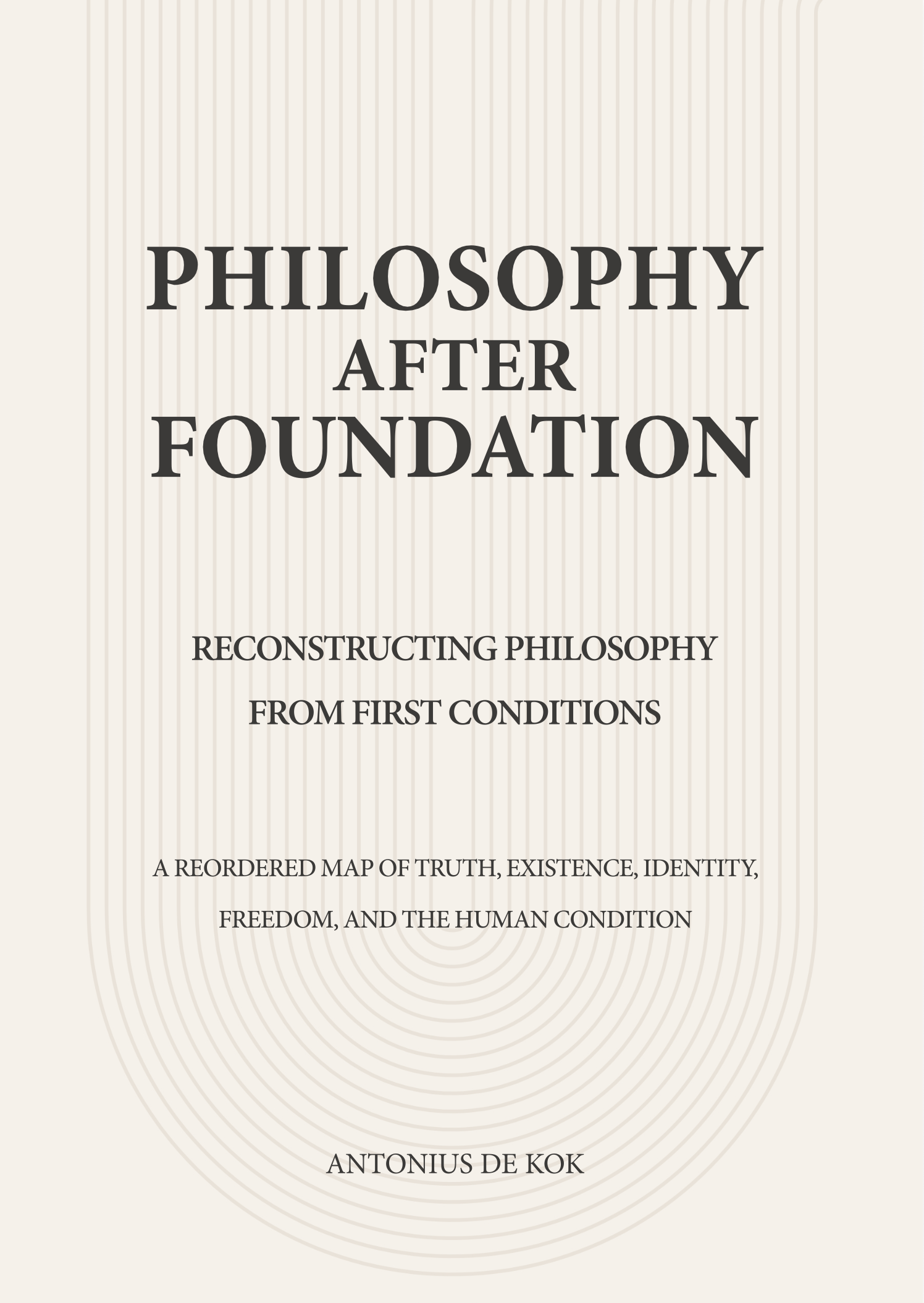
Reconstructing philosophy from first conditions. The book begins with the foundational laws established in my physics work and reasons through their consequences for truth, existence, identity, freedom, and the human condition.
Bring a problem that remains unresolved, or a possibility you cannot yet see how to realize. An Initial Structural Review examines its assumptions and helps define whether further work is warranted.